What a tape holds
A tape is a recording of typed values over time, such as the log lines and currents of a device under test. The values come in many kinds and at rates far apart, and a tape keeps each kind in a form that suits it. Each value is an item, such as one log line or one current sample. The items of one kind form a track, and every item has a time on a clock that the tape defines.
The book uses one recording as its example throughout. A motor controller board, the drive, runs for an hour on an endurance bench, and a host records it over USB. The recording has five tracks:
| Track | What it holds | Rate | Kept in |
|---|---|---|---|
log |
the firmware's log lines | 3 a second | records blocks |
mode |
the controller's mode: idle, run or fault | at each change | a state track |
can0 |
frames on the CAN bus of the vehicle | 1 000 a second | events chunks |
phase_a |
the phase current, in milliamperes as 16-bit fixed point | 25 000 a second | series chunks |
temp |
the board's temperature | once a second | records blocks |
The rates run from once a second to 25 000 times a second. Slow tracks share records blocks, in which every record carries its own track, time and length. A fast track gets chunks of its own, in which the times and values lie in columns. A block of either kind checks itself, so a reader can trust it, or skip it, without reading anything else.
ww_tape_figures from the drive's recording at 1/100 of its data, read back from
its pieces. At full rate a block covers a second, not a minute.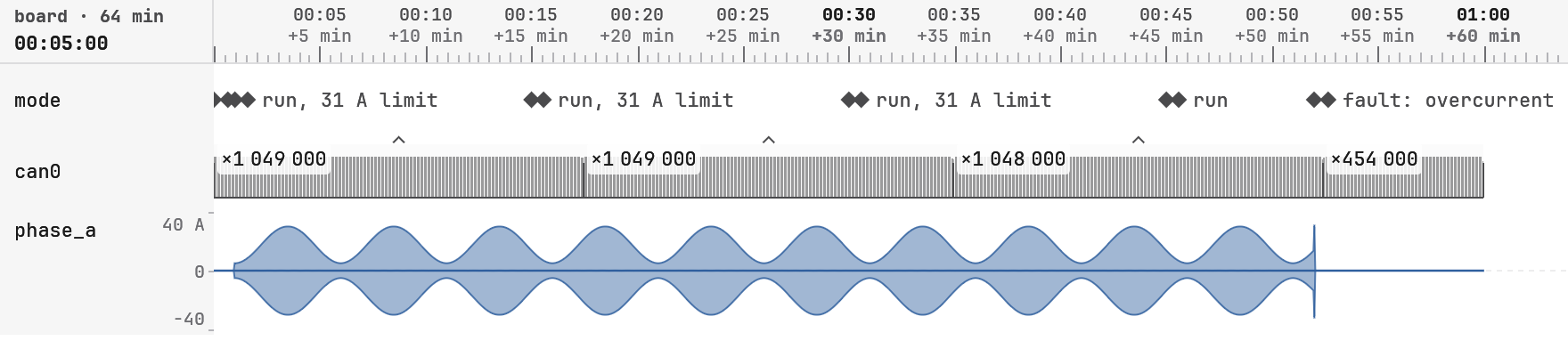
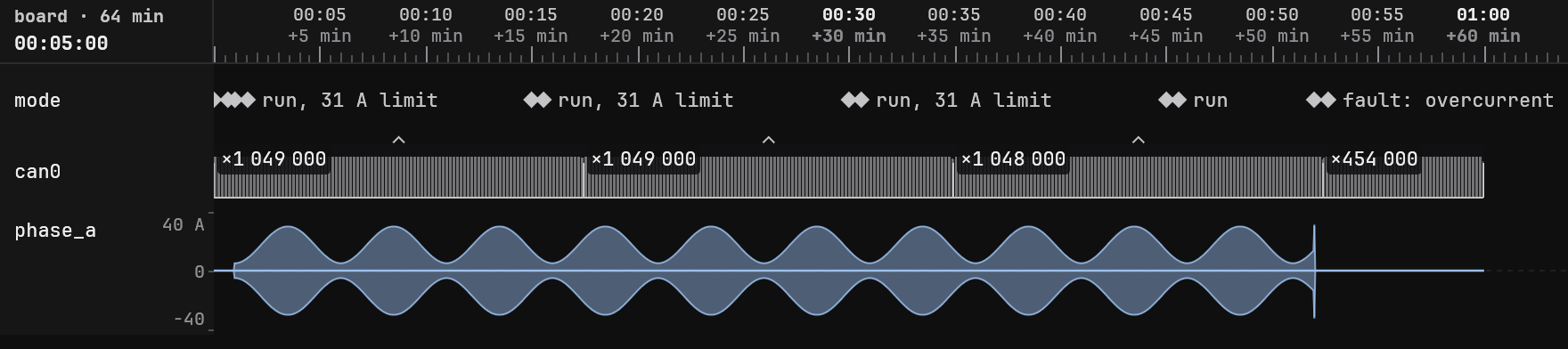
mode row
marks each record of the mode. The can0 row counts the frames in each stretch. The phase_a row
draws the current's range from its summaries, up to the fault in minute 52. A screenshot rendered by
eventfull_book_shots from the recording at full rate.The mode track differs from the other four. Its items are not a stream of events but a state: the mode in
force until the next one. A reader that opens the recording at minute 40 needs the mode in force there, and the
format makes sure it finds that mode nearby.
One format, three uses
The same blocks serve three uses, and a producer picks the one that fits where the data goes. The format does not change between them, so a tool that reads one reads all three.
- A live feed hands each block to a consumer as soon as it exists. A viewer on the bench draws the drive's current while the run goes on.
- A file on a PC holds the recording for later. The bench host keeps the drive's hour this way, and the program of A first tape writes such a file.
- A raw medium, such as an SD card, holds the blocks without a file system. A reader finds the data again after a power failure. The recorder that writes there has a host-class processor and RAM. A recorder that is itself a small device takes logring instead.
What the format is for
Four goals shape the format, and most of its choices follow from them:
- Typed data. The tape carries the definitions of its tracks, including the WireWeaver type of their items. A reader on another PC, years later, knows what the bytes mean without the device.
- Exact time. A time is a whole number of ticks of a named clock with an exact rate. The format rounds nothing to whole nanoseconds, and one tape holds tracks on many clocks.
- Reads in place. A reader queries the columns of a chunk where they lie in the file. It decodes only the items it needs, never a whole track into a list.
- Damage stays local. A crash, a torn write or a flipped bit costs the bytes it touched. A reader reports what it lost and reads the rest.
Nothing in the format knows a particular producer. WireWeaver's link tap writes the records of a link into tapes, and a device logger, a simulator or an analysis program writes the same blocks. WireWeaver and logring gives the background on WireWeaver, the framework for typed APIs that tapes belong to.
State tracks and near use
A state track holds items that stay in force, such as the drive's mode. A reader can start in three places where the history before it is out of reach:
- at minute 40 of a closed recording, without reading the 40 minutes before;
- past a damaged stretch, which it cannot read;
- on a live feed it joined late, whose start it never saw.
The reader needs the item in force there, not the whole history before it. The writer therefore keeps each state item close behind every place that uses it. The producer gives the writer the mode at each use, which the book calls a put. The writer writes the item only when no record of it lies within 32 MiB behind. It also adds one copy, so that one damaged block cannot lose the item.
The definitions of tracks and clocks are state too, kept on track 0 by the same rule. A reader that starts anywhere thus finds every definition and every state item it needs within about 32 MiB. Definitions and state explains puts, copies and how a reader looks state up.
Pieces and chains
A long recording does not go into one ever-growing file. At each cut, the writer ends one piece and starts the next. A piece is a complete file that reads alone, with an index, a close record and a tail at the end. The bench host cuts the drive's hour every 15 minutes, which gives four pieces of about 27 MB to 30 MB.
The pieces of one recording form a chain. Each piece's head names the piece before it by its content hash and its id, and its tail names the next piece by its id. A reader therefore puts pieces in order whatever their file names, and tells when a piece is missing. Deleting the oldest piece frees space, and a reader tells a chain that lost its first pieces this way apart from a damaged one.
A closed piece ends on a multiple of 4 KiB. A file system that shares extents, such as btrfs, can therefore clone pieces back to back into one file without writing any byte again. The result is a valid tape too. Pieces and chains explains cuts, the stores that hold pieces and how a chain links.
The crates
Four crates implement the format. An application that writes files takes ww_tape and ww_tape_fs, and one that
draws summaries adds ww_tape_summary.
| Crate | What it holds |
|---|---|
ww_tape |
the format: blocks, definitions, chunks, the index, pieces, the writer TapeWriter and the reader TapeReader; it builds without the standard library |
ww_tape_codecs |
the column codecs, which know nothing of blocks: bit packing, checksums, varints, lz4, and the codecs of samples, times and lengths; ww_tape re-exports them |
ww_tape_fs |
everything that names a path: the file sink FileSink, the reader's FileSource, and writers and chains opened by path |
ww_tape_summary |
the trees of summaries a viewer draws a long track from |
ww_tape runs on a host. Its writer needs an allocator and keeps the index of the open piece in memory. A piece of 256 MiB in records blocks of 4 KiB takes its heap to tens of megabytes (Sizes and speeds). ww_tape spends that memory on many tracks, an index, summaries, column codecs and chains of pieces.
Firmware on a small device keeps its log in logring instead. That store writes a ring on an SD card or a flash chip with no heap and little RAM. A power cut costs it at most the last second. Tapes and logring compares the two.
TapeReader.mode; the writer keeps its items near their uses.TapeWriter.PieceStore; the book never uses store as a verb.pub struct TapeWriter<S: TapeSink>
Appends blocks to a TapeSink, a file by default, see the module docs.
pub struct TapeReader<S> {
    src: S,
    len: u64,
    /// [ByteSource::start]: no piece is looked for before it
    front: u64,
    /// [OpenOptions::check_payloads] as it applies to the source
    check_payloads: bool,
    pieces: Vec<PieceInfo>,
    /// [OpenOptions::state_read_max]
    state_read_max: u64,
    /// The pieces' state entries sorted, shared by the reader's lookups
    states: state::StateCache,
}
A tape read by positional reads, see the module docs.
pub struct FileSink {
    file: Locked,
    path: PathBuf,
    /// Where the piece being written starts in the file
    base: u64,
    /// The file holds pieces back to back ([TapeSink::holds_pieces])
    pieces: bool,
    /// Set when the file is on a network or user-space file system
    warning: Option<FsWarning>,
}
A file of one piece or of pieces back to back, written under its own name from the start and appended to.
Whether the piece is open, closed or torn is read from its bytes (its close and tail), never from its name.
pub struct FileSource {
    file: File,
    path: PathBuf,
}
A file read by positional reads, a closed piece or any tape: the ByteSource of a file for a TapeReader.